
On the south bank of the Maumee
Countertops in New Haven, IN
Kitchen and bath tops for a city where most people own their homes and stay put, chosen to last as long as you plan to live there.
- Free on-site estimates
- Itemized written quote: material, edges, cutouts, tear-out
- Cabinets checked for level before templating
Buying Counters for the Long Haul in New Haven
When people shop for countertops in New Haven, they are usually not flipping a house. They are choosing a surface they expect to look at for a long time. About 75.7% of homes here are owner-occupied and 90% of residents lived in the same house a year earlier, according to Census estimates. That kind of staying power changes the conversation: durability and easy care tend to matter more than chasing whatever color is popular this year.
A city with layers of history
Henry Burgess platted New Haven in 1839 and named it after the Connecticut city. It was incorporated as a town in 1865, and a Burgess home on Summit Street is still counted as the oldest brick structure in Jefferson Township. Swiss Amish families arrived in the 1850s, and the Alsatian-speaking Amish community around New Haven and Grabill is still there today. A kitchen in an older New Haven house may have been remodeled two or three times, and layers of old laminate, plywood and shims can turn up under the top being removed.
What tends to work in New Haven homes
For a house you plan to stay in, materials that age well with little fuss make sense:
- Quartz for busy family kitchens, since it resists stains and never needs sealing
- Granite for anyone who likes natural stone and does not mind an occasional reseal
- Vanity tops in quartz or cultured marble for hall baths and primary baths
- Solid surface for a seamless look with an integrated sink
- Laminate where a basement kitchenette or laundry folding counter does not need stone
We bring samples to the house so you can see them next to your cabinets, floor and the light from your own windows.
Built on an old lakebed
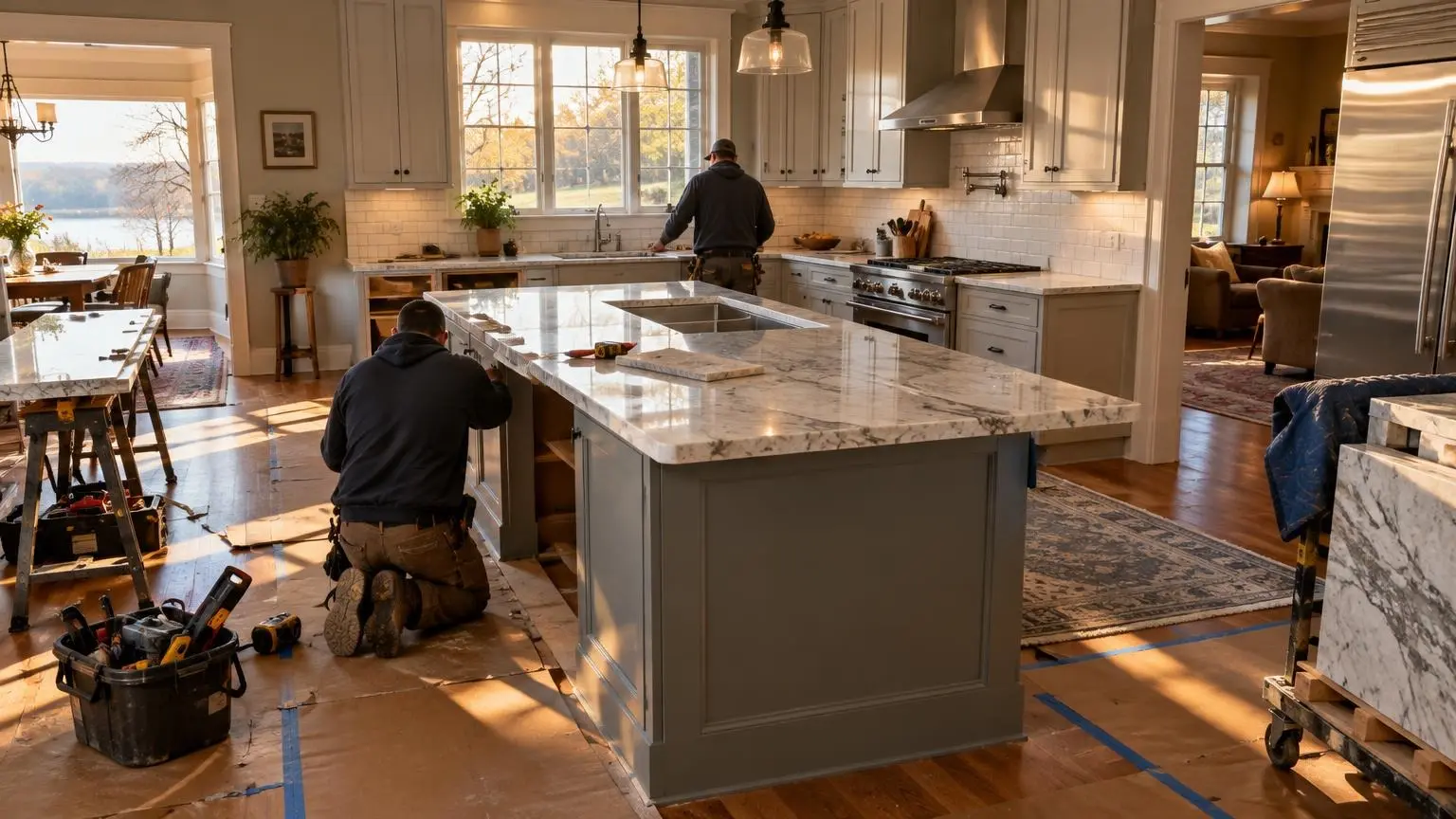
New Haven sits at the western edge of what was once glacial Lake Maumee, whose bed later became the Great Black Swamp that stretched east into Ohio. The swamp was drained for farmland between 1859 and 1885. Whatever the ground, any house that has stood for decades can settle, and inside that shows up as floors and cabinets that are not quite level. A natural stone or quartz slab will not bend to follow a dip, so we check level across every run of cabinets and correct it before the template goes down.
Fitting a top around a settled kitchen
In long-owned homes, previous projects leave their marks. A dishwasher may have been added without a proper support rail, or an old cast-iron sink may be holding the cabinet together more than the cabinet is holding the sink. We look for those details at the estimate so the quote reflects the real job. If a sink or cooktop is moving to a new spot, the plumbing change may need a permit through the county building department; we flag that so it does not slow down install day.
Close to Fort Wayne
New Haven sits just east of Fort Wayne, which makes it easy to come back for a second look if you are torn between two slabs, or to schedule the template and install close together. Call (260) 823-4488 to set up a visit, or use the form to send photos first.
New Haven at a Glance
- Owners who stay. About 75.7% of New Haven housing is owner-occupied, and 90.0% of residents lived in the same home one year earlier (Census ACS, 2020 to 2024).
- Platted in 1839. Henry Burgess laid out New Haven in 1839. It was incorporated as a town in 1865, and a Burgess-built house on Summit Street is the oldest brick structure in Jefferson Township.
- Edge of the Great Black Swamp. New Haven was the westernmost point of glacial Lake Maumee, whose bed became the Great Black Swamp. The swamp's central fragment began near New Haven and was drained for farmland between 1859 and 1885.
- A modest, steady housing stock. The 2020 census counted 6,669 housing units in New Haven, with a homeowner vacancy rate of just 1.1%, so most homes stay occupied and get updated in place rather than turned over.
New Haven Questions
Is quartz or granite better for a house I plan to keep for 20 years?
Both hold up for decades. Quartz needs less care because it never needs sealing and resists stains well. Granite is natural stone, can take hot pans better and has one-of-a-kind patterns, but benefits from resealing from time to time. Either works well in a bath; for a busy kitchen, quartz asks the least of you.
My older New Haven kitchen has floors that slope. Can you still install stone?
Yes. Uneven settling is common in older houses. We level the cabinets with shims and, if needed, reinforce them before templating. The countertop ends up level even if the floor is not.
Do you remove the old countertop?
Yes. Tear-out and haul-away can be part of the quote. Older homes can hide layers of earlier counters underneath, so we account for that once we have looked at the kitchen in person.
Free Estimates in New Haven, IN
Free estimates for New Haven homeowners.
Countertops Near New Haven
- Countertops in Fort Wayne, IN
- Countertops in Huntertown, IN
- Countertops in Leo-Cedarville, IN
- Countertops in Grabill, IN
- Countertops in Woodburn, IN
- Countertops in Auburn, IN
- Countertops in Columbia City, IN
- Countertops in Huntington, IN
- Countertops in Decatur, IN
- Countertops in Bluffton, IN
- Countertops in Kendallville, IN
- Countertops in Garrett, IN
- Countertops in Angola, IN
- Countertops in Warsaw, IN
- Countertops in Churubusco, IN
- Countertops in Roanoke, IN
- Countertops in Ossian, IN